Blog Assenssement

Finally , I Change my topic to Imbedded AI and VR in English learning as second language.

My paper mainly studies how to apply AI and VR to English education. I will introduce what AI and VR technologies are, and their development and evolution, including the traditional education methods in today’s society and the inability to meet the needs of today’s society. The integration of AI, VR and education has become an irreversible trend. Besides, AI and VR can improve the quality of education and help students make progress. I will use some cases and practical AI and VR systems that have been used in education to prove the effectiveness of AI and VR for education. Then I will propose four advantages of using AI and VR in education: immersive learning, one-to-one personalized teaching experience, support for special education, and students’ independent learning. As well as talking about the points to pay attention to when using AI and VR, as well as the current shortcomings of these two technologies. Finally, I will discuss how to use AI and VR in English learning.

Reference list:

Bringsjord, S., & Schimanski, B. (2003, August). What is artificial intelligence? Psychometric AI as an answer. In IJCAI (pp. 887-893).

5 Ways AI Is Changing The Education Industry. (2019, February 15). Retrieved from https://elearningindustry.com/ai-is-changing-the-education-industry-5-ways

Guo, J., Hu, H., Zhang, X., Chen, Y., Pei, Q., Ren, H., … Fu, G. (2017). SeLL. SIGGRAPH Asia 2017 Symposium on Education on – SA ’17. doi:10.1145/3134368.3139213

Lemke, J. L. (1993). Education, Cyberspace, and Change [Serial Article Online]. Electronic Journal on Virtual Culture, 1(1), n1.

Luckin, R., Holmes, W., Griffiths, M., & Forcier, L. B. (2016). Intelligence unleashed: An argument for AI in education.

Schank, R. C. (1987). What is AI, anyway?. AI magazine8(4), 59-59.

Steuer, J. (1992). Defining virtual reality: Dimensions determining telepresence. Journal of communication42(4), 73-93.

Youngblut, C. (1998). Educational uses of virtual reality technology (No. IDA-D-2128). INSTITUTE FOR DEFENSE ANALYSES ALEXANDRIA VA.

Annotated Bibliography 1

Article: Formal Analysis and Application of the New Mode of “VR+ Education”

Author: Xiangyu Meng

This article is talking about VR+Education is the development trend of education technology in the future. In view of the difficult problems, the virtual reality technology combined with education technology, based on the purpose, to adapt to the future development method of formal logic is used to analyze the promotion condition of “virtual reality + education”, and put forward the application strategy and impact assessment. It can provide reference for the practical application of new model in the field of teaching.

The author argue that VR can provide learners with free learning space and stimulate their learning interest and enthusiasm. VR (virtual reality) refers to the technology that provides immersion in the interactive three-dimensional environment generated on the computer by using computer graphics system, realistic sense, control force and other interface devices. It USES computer generated simulation environment. It is a kind of interactive 3d dynamic scene and entity behavior system simulation based on multi-source information fusion. If VR technology is widely understood, it is the use of computer technology to help you achieve your “daydreams”. In this process, VR technology will simulate a real 3d virtual world and make learners feel the effect of immersion through vision, hearing, smell, touch and taste.

Virtual reality technology has advantages that traditional teaching methods do not have. First, it is reflected in the creation of the situation. Virtual reality technology can create a real and intuitive learning environment for learners, promote their understanding and mastery of knowledge, fully mobilize their enthusiasm and initiative in learning, and enhance their understanding of knowledge. It is very important to master knowledge and cultivate learners’ independent learning ability. At the same time, the creation of virtual scene is beneficial to improve the innovation ability and thinking ability of learners.

In addition, virtual reality technology can make up for the shortcomings of traditional teaching methods and minimize the obstacles caused by safety, economy and other problems. Through virtual reality technology, rare natural landscapes can be displayed, some experimental dangers can be avoided, and can be reused. New VR technology combined with puzzle game, situational learning, cooperative learning, distance education and other characteristics will solve many educational problems that could not be solved before, and let us feel the all-round education.

For me, learning English is very boring. Many students also feel difficult and disinterested in learning English especially composition. If we can use VR to learn English, it will greatly improve students’ interest in learning. Besides, VR can provide immersive learning and simulate various environments. Speaking is also a difficult part for students, so VR can provide an all English environment to help them improve their speaking and listening. This article helps me explain why VR technology should be used in English learning and to what extent it can help students learn English.

Annotated Bibliography 2

Article:Intelligence Unleashed: An argument for AI in Education

Author:The Open University’s repository of research publications and other research outputs

Many AI-driven applications are already in use in our schools and universities. Many schools use a combination of AIEd and educational data mining (EDM) techniques to “track” student behavior — for example, sequential collection of classroom attendance and assignment submission data to identify (and support) students at risk of quitting school.

AIEd can provide every learner with an intelligent, personalized mentor

In the 1970s, some of the first artificial intelligence systems were introduced to provide personalized and adaptive teaching. BUGGY15, for example, is a breakthrough system designed to teach basic addition and subtraction, using a model that reflects the misunderstandings that learners may have in process arithmetic. This “bug library” is actually a domain model of the system that diagnoses every mistake a student makes to provide appropriate guidance.

Instead of using models, it USES machine learning techniques, self-training algorithms based on large data sets, and neural networks to enable them to make appropriate decisions about what to offer learners in learning content.

There is no doubt that in the next phase of AIEd, teachers need to be central agents. In a sense, it’s obvious — teachers will be coordinators of when and how to use these AIEd tools. In turn, AIEd tools, and the data-driven insights they provide, will enable teachers to decide how best to organize the resources at their disposal.AIEd does a good job of taking on some of the tasks we currently expect teachers to do, such as marking and recording.

Freeing teachers from daily, time-consuming tasks will allow them to channel more energy into creative, very human behaviors that provide the ingenuity and empathy needed to take learning to the next level.

The third part of this article describes what current AI education can do, which can provide one-on-one guidance to students, serve as a team, and simulate a real environment. The biggest effect of this article is to provide the application of AI education in real world. Because many people doubt about AI is whether AI will often make system mistakes in actual operation, which leads to the failure of teaching progress. This article provides a good example to break this doubt.

Annotated Bibliography 3

Article:SeLL: Second Language Learning Paired with VR and AI

Author:Juan Guo

In this article, the author and his team developed an English learning system that combines virtual reality with artificial intelligence. they demonstrate that auditory and visual immersion experiences related to English expose learners to more listening and speaking skills.

The system integrates artificial intelligence such as automatic speech recognition and speech assessment, which can evaluate learners’ listening and speaking ability.

By design, the English test in China mainly focuses on four aspects: grammar, reading, writing and listening, which leads to the so-called “dumb English”.

The English learning system established by the author mainly simulates the learning environment

1. Virtual teaching tools

A variety of teaching AIDS are designed, such as whiteboard, document sharing, video viewing in virtual environment, etc. The virtual whiteboard is used to convey the ideas of learners, and all learners can see the contents of the whiteboard in real time. These tools help learners share information via text messages, pictures or video.

2.Task-based learning

A variety of language related to design and complete the tasks are English learners, and is expected to improve oral English skills. The town provides a range of business activities and places, such as bookstores, schools, theaters, restaurants and so on. Learners communicate through language. The learner’s task is designed for verbal communication, either with another learner or with an artificial intelligence-driven avatar.

3 natural interaction

Natural interactions allow for continuous immersion. When the speech is delivered in a natural way, learners interact naturally with the virtual characters through language, which simulates the communication process in the real world. In the traditional computer-aided learning process, learners interact with each other via mouse and keyboard. In order to avoid such interaction, it is necessary to ensure that virtual characters understand the learner’s words and then react accordingly.

This article is very specific about how AI and VR are applied in the process of English learning. It provides specific steps and teaching means, which proves that AI and VR can be applied in English teaching. In addition, it can relieve teachers of great burden and pressure, and help students improve their interest and performance in English learning in an all-round way. This article helps me to increase the credibility of my article.
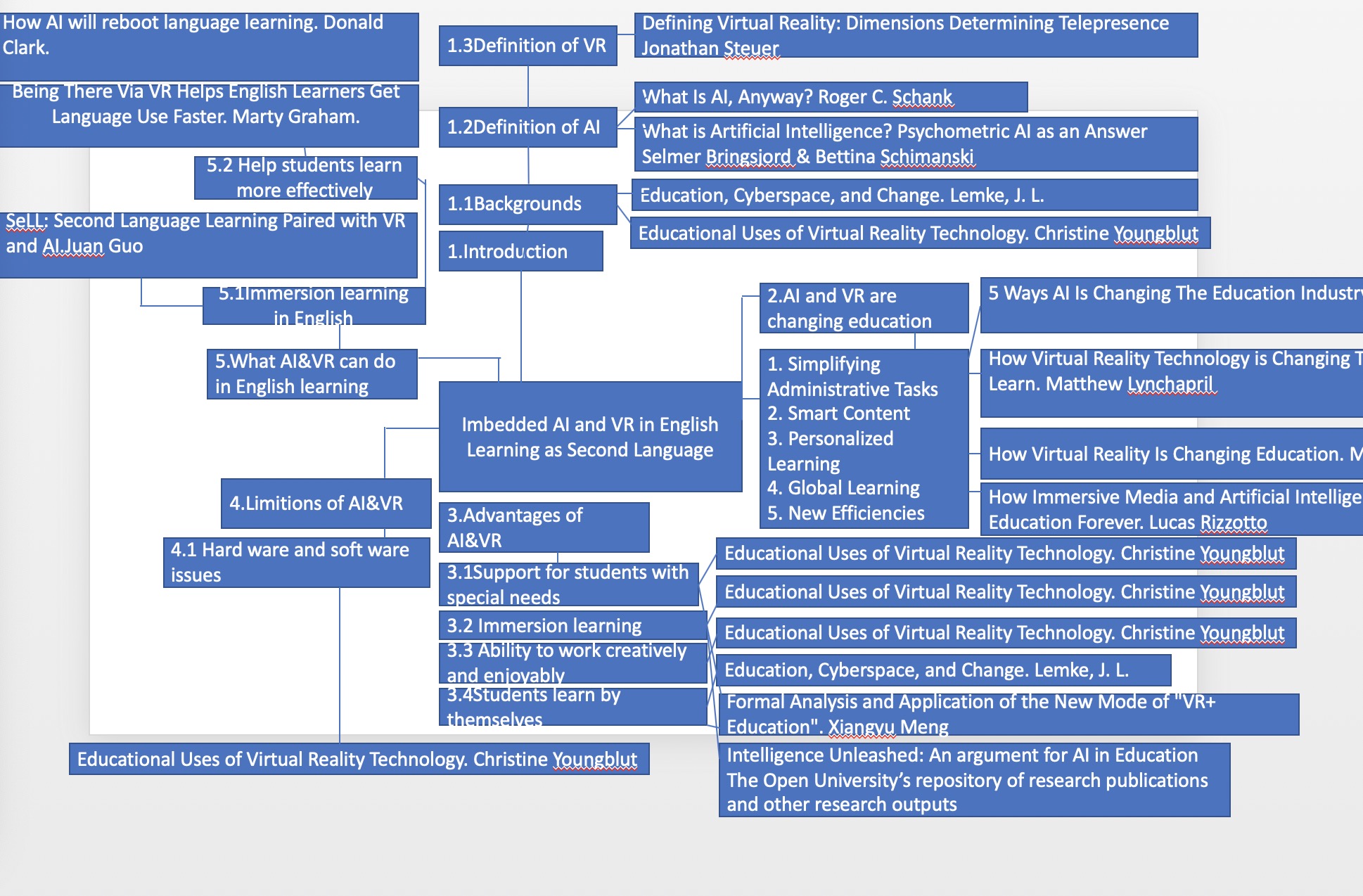

My article is divided in 5parts

#3 AI in medical education—another grand challenge for medical informatics

I finally found an article about the application of AI in medical education. The article also mentioned that although AI is used in many fields of education, there is little interest in medical education.

The article notes that health care workers achieve their potential when they feel safe about what they are doing; They understand their environment; Their jobs are becoming more complex; They can participate in the decision-making process; They learn from their own experiences. In other words: job satisfaction and self-esteem increase with knowledge, skills, and job performance, and vice versa.
The idea of computer-based applications as an aid to educating and training medical staff is not new. However, as the references point out, the methods traditionally used to implement these applications do not support the mechanisms needed to address individual differences and the complexity of medical problem solving and decision making. A solid foundation in cognitive science and artificial intelligence is needed to meet the needs of effective computer medicine education and training.

Throughout the paper, we have touched upon the common interests of at least three different research fields: objectives; Artificial intelligence in education; Computer education in traditional medicine. So far, these disciplines have not merged to work together for the benefit of health care.
Although there are a lot of difficulties in medical education research but if more of the attention of the medical education research, medical informatics, AI [and medical education computer. AI has the potential to provide a solution: “to solve the effectiveness of medical education and the needs of the correlation between”; “while reduce the medical cost, improve medical quality and service quality”, “to prove that the positive influence on health care”; “it into the education and the power of the informatics”. Through the AIME medical (AI) of aim, the author thinks that the AI in medicine actual success would eventually be able to achieve it.

This article has strengthened my confidence in the application of AI in the field of education. Even such a complex subject as medicine can provide help and solutions, let alone its application in other disciplines.

Reference:

Lillehaug, S. I., & Lajoie, S. P. (1998). AI in medical education—another grand challenge for medical informatics. Artificial Intelligence in Medicine12(3), 197-225.

#2 Applications of AI in Education

This article begins with an overview of the main components of an intelligent tutoring system. Then it summarizes the different types of intelligent tutoring systems and discusses in detail the student model and teaching module as well as the future development direction.


Intelligent tutoring systems have been shown to be effective in improving student performance and motivation. For example, students using Smitihtown, an ITS for economics, perform just as well as students taking traditional menstrual blood courses, but using only the half time.

In the student model section, the intelligent assistance system stores personal learning materials belonging to each student, and records the performance of students every minute. The good and bad information is collected so that teachers can make better adjustments to students’ progress. Under the teaching module, This component provides a model of the teaching process. For example, information about when to review, when to present a new topic, And which topic to present is controlled by the pedagogical module. As mentioned earlier, the student model is used As input to this component. So the pedagogical decisions reflect the differing needs of each student.
Learning aid systems can also provide real-world simulations to help students learn. An example of a simulation-based ITS is the Advanced Cardiac Life Support (ACLS) Tutor in which a student takes the role of team leader in providing emergency Life Support for patients who have “Had heart attacks.” also, smart assort systems emphasize communication and presentation systems to ensure student learning outcomes.


It can be seen in this article that AI has played a great role in teaching, which can indeed help students to learn better, help teachers to reduce workload and help students to make progress faster and more efficiently. But it also mentions some of AI’s current problems, such as long development time and relatively complex operation. This is the place where in the future in the popularization of AI education need to be focused on.

Reference:

Beck, J., Stern, M., & Haugsjaa, E. (1996). Applications of AI in Education. Crossroads3(1), 11-15.

#1 AI Grand Challenges in Education

In this article firstly talked about the current education: fixed classroom, lectures and static printed textbooks has been unable to service to the society or the flexibility to adapt to the future. Classrooms and textbooks are particularly unsuitable for people who use mobile and digital technology every day. This article focuses on five aspects in which ai can contribute to achieving long-term educational goals.

Firstly, artificial intelligence can be mentors for every learner. As far as I understand, artificial intelligence can build customized learning plans for each learner. Because AI can explain students’ strengths, weaknesses, challenges and motivations through calculation, and can interact with students like human mentors. AI can also support group learning, and web tools can facilitate individual learning within communities, community building knowledge, and community learning from each other.

The second area is 21st-century skills. Workers in the 21st century need both “hard” skills and “Soft” skills (teamwork, reasoning, disciplined thinking, creativity, social skills, metacognitive skills, computer literacy, and the ability to evaluate and analyze information) are also required. AI can help students create seamless social drama. With the support of artificial intelligence, social learning is developing and continuing outside of school, where students can learn at any time.

Third, explore and leverage the unique data types available in the educational environment and use these data to better understand students, communities, and the environment in which they learn. American school reform relies on data management and mining, recording and tracking student achievement and classroom productivity, and analyzing data to prepare students for success in college and in the workplace.

The fourth aspect is the classroom. AI can provide students with universal, inclusive, anytime, anywhere learning. Global classroom is what AI can do. Global classroom, like ted, open courses in famous universities, provides the best education for learners around the world. Even if you don’t get admitted to an elite school, you can enjoy the resources of elite schools. This also explains educational fairness to a large extent.

Fifth, lifelong learning. One feature of mobile technology and social networks is that they provide seamless and ubiquitous learning across established boundaries. For instance, The distinction between formal and informal (in the classroom) (outside of the classroom) education may disappear as learners gain knowledge equally well outside and inside the classroom.
An additional aspect of lifelong learning is to develop teacher professional training so teachers might keep up with the next generation of education standards and pedagogical approaches. Knowledge and practice have a direct correlation with student achievement.

After reading this article, I believe that AI will really help the development of education. Among them, I has the great impression about the fairness of education. In addition to the inequality of educational resources, some people cannot go to school due to the problem of money even if their scores meet the requirements of the school. AI and network have greatly reduced the cost of education and provided many people with access to the resources of famous universities, especially the open courses of famous universities. It was a great experience for me to look the happiness course of Harvard on Youtube.

Woolf, B. P., Lane, H. C., Chaudhri, V. K., & Kolodner, J. L. (2013). AI Grand Challenges for Education. AI Magazine34(4), 66. doi:10.1609/aimag.v34i4.2490

Brainstorm: The Connection between AI,VR and Education

When I research the articles about AI and VR to be used in medical teaching or

At first, it was because of my bad experience in anatomy and my cousin’s experience that I began to think of AI and VR technology, and I saw a doctor in a good doctor who used VR technology to simulate heart surgery and judge the risk and success rate of surgery. When I searched the Internet for how AI and VR were applied in medicine or biology classes, I found that VR and AI had already been applied in other courses. However, I did not find any article on the application of VR and AI in medicine and biology. So I thought I’d just switch gears and look at how AI and VR are being used in real teaching and how these two technologies can increase student engagement in the classroom.

In my article, I would like to discuss the theoretical basis of the application of AI and VR in teaching, as well as the different attitudes and views of different scholars towards VR and AI. Then we will discuss the advantages of these two technologies in use and what should be paid attention to. Finally, find some successful practical examples to support these two technologies. Just like in the following video, when the teacher USES VR technology in the math class, the students feel very surprised and interesting. VR presents a very real math environment. The students were very active and thought it was very helpful for their study.

Also mentioned in theory, lifelong learning is to increase the students’ learning interest and enthusiasm to study materials can be manipulated, and the most mentioned in the article is a lego, lego is very good teaching tool, but in addition to the lego we also need more other material of operability, lego may not apply to any subject, after all. Therefore, AI and VR complement the deficiency of lego. And when I searched for information, I found that VR is actually a part of AI, which is changing education and people’s way of learning to a great extent. It can not only reduce the pressure of teachers, but also give students personalized customization, and can be learned anywhere in the world in the future.

When I research the articles about AI and VR to be used in medical teaching or

Reflection on Educational Technology:Big change of ET

At the beginning of the class, the concept of educational technology was very vague, believing that educational technology was a variety of AIDS and computer applications related to education. Only after class did I begin to realize that educational technology covers a wide range of implications. It not only refers to all kinds of hardware equipment related to education, but also includes software equipment, educational process and various educational concepts. In the process of education, teachers’ educational goals and students’ learning interests are taken into account. Based on this basic concept, the process and results of education are reflected, and then the tools and technologies are studied to maximize the completion of educational goals and help students make better progress in learning. Thus, after the class, it really changes my thoughts on Educational Technology. It gives me a concrete idea, that the basic and the critical concept about education is to help students to learn in a right and effect way.

When I was in junior high school, I had anatomy in biology class, including fish anatomy and frog anatomy. In order to study the function of the fins we have to remove the fins step by step, and dissect the frog. It is very cruel for girls. Nearly 20 years later, I still remember my fear when dissecting fish and frogs. So I wonder if there’s any educational technology that can mimic real fish and frogs without actually killing them to learn.

My cousin sister is a nurse and she has shared with me that they need to learn about human bodies by dissecting cadavers. First of all, it’s very difficult for medical schools to find bodies, and most of the bodies are old people, and sometimes medical schools need young bodies to teach. And for the students, in the face of the body is a very big challenge, my cousin and I occasionally speak of her things in anatomy class, most of the students start are very afraid of need a lot of time to adjust psychology, is not only the face of the body in class mentality, and also want to spend a lot of time to do psychological debugging. The article Shared by Eva has examples of lego application in various disciplines, such as programming, physics, biology and so on. Based on this, and modern technology has been very developed, will there be any technology can be applied to biological anatomy and medical education.